
Estimated reading time: ~14 minutes
Artificial intelligence has become a familiar term in commodity markets, from energy and metals to agricultural products. But there is a wide gap between what AI commodity trading actually does and what many people imagine it does. This guide explains, in plain language, how AI works in commodity trading in 2026 — the real mechanics, the honest limitations, and the risks every trader should understand before relying on an algorithm.
What “AI Commodity Trading” Actually Means
When people hear “AI trading,” they often picture software that predicts the future. In reality, AI in commodity trading is a set of statistical and machine-learning techniques that detect patterns in historical and live data, then act on probabilities. It does not know what oil, gold, or wheat will do tomorrow, and it cannot remove uncertainty. A more accurate description is that AI is a fast, tireless pattern-matcher that follows rules — some written by humans, some learned from data.
This distinction matters enormously in commodities, where prices are shaped by weather, geopolitics, storage costs, and supply shocks that no model can fully anticipate. Treating a probability engine as a crystal ball is the most common and most costly mistake in automated trading.
The Building Blocks of AI in Commodity Trading
Machine Learning Models
At the core of most systems are machine-learning models trained on historical price data, futures curves, and other signals. Common approaches include supervised learning to estimate the probability of price moves, reinforcement learning agents that learn a trading policy in simulation, and time-series models built for sequential data. Each has trade-offs in accuracy, stability, and how badly it breaks when market conditions change.
Data Inputs: Supply, Demand, Weather and Geopolitics
Commodities are unusually data-rich. Beyond price and volume, models may ingest inventory and storage reports, crop and harvest data, weather forecasts, shipping and freight rates, energy production figures, and geopolitical news. The quality, timeliness, and cleanliness of this data directly determine how useful the model’s output is. In commodity markets, a single weather event or export ban can override months of historical pattern.
Sentiment and Alternative Data
Many modern systems add natural-language processing to gauge sentiment from news and reports, and some use alternative data such as satellite imagery of crops, storage tanks, or shipping activity. These can be valuable, but they are noisy and sometimes ambiguous. They are best treated as supporting context rather than standalone trade triggers.
How an AI Trading Decision Is Made
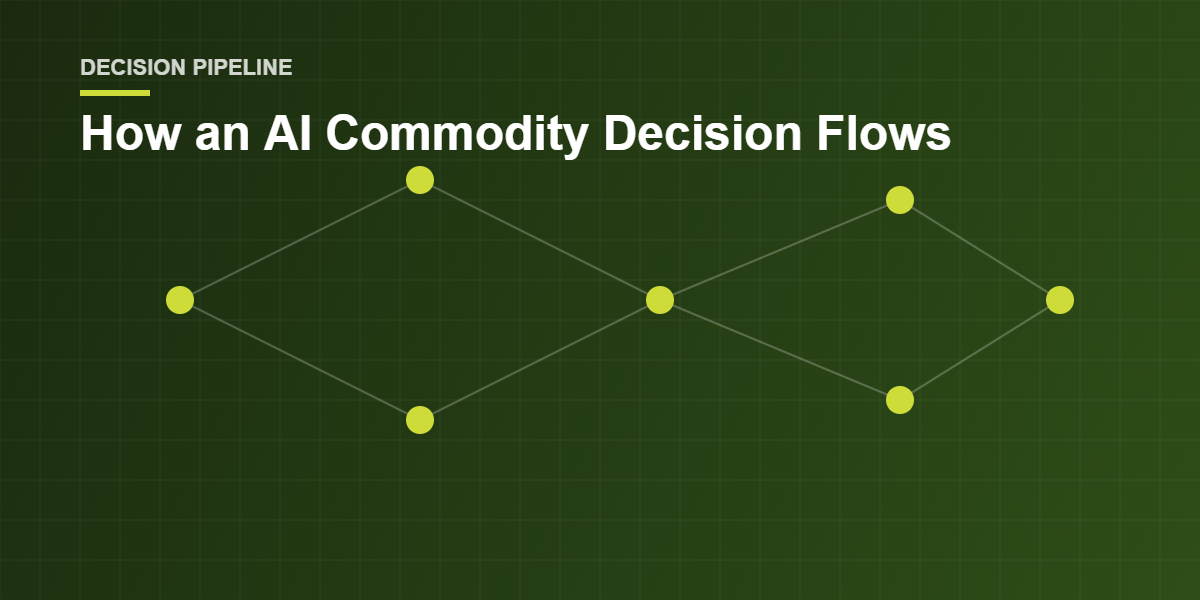
Stripped to essentials, a decision usually follows a chain: collect and clean incoming data; transform it into features the model understands; feed those features into the trained model to produce a probability or score; pass that score through risk rules that decide position size and whether to trade at all; then send an order to the market. The model is one link in the chain. The risk layer that wraps it often separates a sustainable system from a damaging one.
Automated Futures Execution
Backtesting and Its Traps
Before going live, strategies are backtested against historical data. Backtesting is essential, but it is also where most strategies look far better than they later perform. Overfitting — tuning a model so tightly to past data that it captures noise rather than signal — produces beautiful historical curves and disappointing live results. Ignoring fees, slippage, and roll costs on futures further inflates backtests.
Slippage, Liquidity and Contract Rolls
In live markets, the price you see is not always the price you get. Slippage, latency, partial fills, and thin liquidity in some contracts all erode theoretical performance. Commodity futures also require rolling positions between contract months, which carries its own costs. A realistic system accounts for these frictions from the start rather than discovering them after deployment.
What AI Does Well — and What It Cannot Do
AI is genuinely strong at processing large volumes of data quickly, enforcing discipline without emotion, monitoring many markets at once, and executing a defined plan consistently. In commodities, it can also help integrate diverse data sources that would overwhelm a human analyst.
What AI cannot do is just as important: it cannot foresee genuinely unprecedented events, it cannot guarantee profits — which is why whether AI is worth using depends so much on the user, and it cannot adapt instantly to a market regime it has never seen. A sudden export ban, a refinery outage, or an extreme weather season can invalidate a model trained on calmer history. No honest provider claims otherwise.
The Real Risks Every User Should Understand
Several risks deserve explicit attention. Overfitting makes a strategy look reliable until live conditions diverge from training data. Black-box opacity means some models cannot explain why they trade, making failures hard to diagnose. Regime shifts and commodity-specific shocks can invalidate a model overnight. Data quality issues silently corrupt decisions. And over-reliance — trusting a system you don’t understand and leaving it unmonitored — turns a tool into a liability. Leverage, common in futures, amplifies every one of these risks.
How to Use AI Tools Responsibly
Responsible use starts with risk management, not with the algorithm. Decide in advance how much you are willing to lose, use position sizing and stop rules, and never deploy money you cannot afford to lose. Start small, monitor actively, and treat any AI tool as an assistant rather than an autopilot. Understand the fees, the withdrawal terms, and who holds your funds. If you are unsure whether a provider is licensed, check official registers such as the CFTC or FCA. If a platform’s strategy is completely opaque or its results sound too good to be true, treat that as a reason for caution rather than excitement.
Frequently Asked Questions
Can AI predict commodity prices accurately?
No tool can predict prices reliably. AI works with probabilities based on past patterns, and commodity markets are especially prone to sudden shocks that break those patterns. Treat any claim of accurate prediction with strong skepticism.
Is AI commodity trading suitable for beginners?
Beginners can use AI tools, but they should first understand commodities, futures, leverage, and risk management. Relying on a system you don’t understand is risky regardless of how advanced it appears.
Does AI trading guarantee profits?
No. Any tool or platform promising guaranteed profits should be treated as a serious warning sign. All trading carries the risk of loss, and commodities can be highly volatile.
What data does AI use in commodity trading?
Typical inputs include price and volume, inventory and storage data, weather forecasts, crop reports, shipping rates, energy output, and news sentiment. Model quality depends heavily on the quality of this data.
Why is overfitting a problem?
Overfitting is when a model is tuned so closely to historical data that it captures noise instead of genuine patterns. It produces impressive backtests but often performs poorly in live markets.
Should I leave an AI commodity bot running unattended?
It is unwise to leave automated systems completely unmonitored. Markets change, connections fail, and models drift. Active oversight remains essential, especially with leveraged futures.
Are AI commodity trading tools regulated?
Regulation varies widely by jurisdiction and provider. Before using any platform, verify its regulatory status, licensing, and how it safeguards customer funds.
Summary
AI in commodity trading in 2026 is a powerful tool for processing diverse data and enforcing discipline, but it is not a crystal ball and not a shortcut to guaranteed returns. The traders who benefit most understand both its strengths and its limits, wrap any model in solid risk management, and stay involved rather than handing over control. If you are exploring AI tools, take your time, start small, verify every claim, and prioritize understanding over hype.
Related Reading
For independent background on algorithmic and commodity trading, see educational resources such as Investopedia on algorithmic trading. To verify whether a provider is regulated, consult official bodies such as the U.S. CFTC, the UK FCA, or the EU ESMA.
Disclaimer: This article is for educational and informational purposes only and does not constitute financial, investment, or trading advice. Commodity and futures trading carries a high level of risk, including the potential loss of more than your initial capital when leverage is involved. Past performance and backtested results do not guarantee future outcomes. Nothing here is a recommendation to buy, sell, or use any specific product, platform, or strategy. Always do your own research and consider consulting a licensed financial professional before making any financial decision.

 English
  German
  Polish
  French
  German (Switzerland)
  Croatian
  Czech
Czech  Italian
  Spanish
  Swedish
  Portuguese (Portugal)
  Portuguese (Brazil)
  Japanese
  Thai
Thai  Danish