
Temps de lecture estimé : environ 14 minutes
L'intelligence artificielle est devenue un terme courant sur les marchés des matières premières, de l'énergie et des métaux aux produits agricoles. Mais il existe un fossé important entre ce que représente le trading de matières premières par l'IA et ce que représente l'IA. en fait Ce guide explique, en termes simples, comment l'IA fonctionne dans le négoce des matières premières en 2026 : ses mécanismes réels, ses limites avérées et les risques que tout trader doit comprendre avant de se fier à un algorithme.
Que signifie réellement le “ trading de matières premières par l'IA ” ?
Quand on parle de “ trading par IA ”, on imagine souvent un logiciel qui prédit l'avenir. En réalité, dans le négoce des matières premières, l'IA repose sur un ensemble de techniques statistiques et d'apprentissage automatique qui détectent des tendances dans les données historiques et en temps réel, puis agissent en fonction des probabilités. Elle ne peut pas prédire l'évolution du pétrole, de l'or ou du blé demain, et elle ne peut pas éliminer l'incertitude. Une description plus juste serait de dire que l'IA est un système rapide et infatigable de reconnaissance de formes qui suit des règles – certaines définies par des humains, d'autres apprises à partir des données.
Cette distinction est cruciale pour les matières premières, dont les prix sont influencés par les conditions météorologiques, la géopolitique, les coûts de stockage et les chocs d'approvisionnement qu'aucun modèle ne peut prévoir avec certitude. Considérer un moteur de probabilités comme une boule de cristal est l'erreur la plus fréquente et la plus coûteuse du trading automatisé.
Les fondements de l'IA dans le négoce de matières premières
Modèles d'apprentissage automatique
La plupart des systèmes reposent sur des modèles d'apprentissage automatique entraînés à partir de données historiques de prix, de courbes de contrats à terme et d'autres signaux. Parmi les approches courantes, on trouve l'apprentissage supervisé pour estimer la probabilité des variations de prix, les agents d'apprentissage par renforcement qui apprennent une stratégie de trading par simulation, et les modèles de séries temporelles conçus pour les données séquentielles. Chacune de ces approches présente des compromis en termes de précision, de stabilité et de sensibilité aux fluctuations du marché.
Données d'entrée : Offre, demande, météo et géopolitique
Les matières premières génèrent une quantité exceptionnelle de données. Outre les prix et les volumes, les modèles peuvent intégrer des rapports sur les stocks, les données relatives aux récoltes, les prévisions météorologiques, les tarifs de transport maritime et aérien, les chiffres de la production énergétique et l'actualité géopolitique. La qualité, la disponibilité et la fiabilité de ces données déterminent directement l'utilité des résultats du modèle. Sur les marchés des matières premières, un seul événement météorologique ou une interdiction d'exportation peut anéantir des mois de tendances historiques.
Données sur les sentiments et données alternatives
De nombreux systèmes modernes intègrent le traitement automatique du langage naturel pour analyser le sentiment exprimé dans les actualités et les rapports, et certains utilisent des données alternatives telles que l'imagerie satellite des cultures, des réservoirs de stockage ou du trafic maritime. Ces données peuvent s'avérer précieuses, mais elles sont souvent bruitées et parfois ambiguës. Il est préférable de les considérer comme un élément de contexte supplémentaire plutôt que comme des déclencheurs de transactions à part entière.
Comment une décision de trading prise par une IA est-elle prise ?
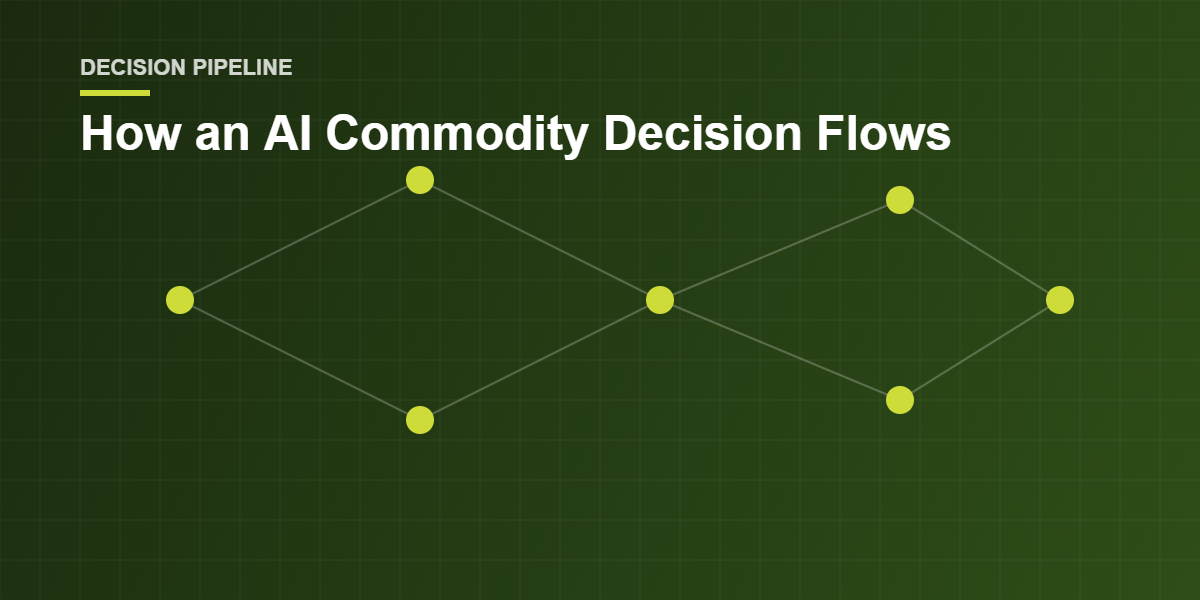
En résumé, une décision suit généralement un processus en plusieurs étapes : collecte et nettoyage des données entrantes ; transformation de ces données en caractéristiques compréhensibles par le modèle ; intégration de ces caractéristiques dans le modèle entraîné pour produire une probabilité ou un score ; application de ce score à des règles de risque qui déterminent la taille de la position et l’opportunité de trader ; enfin, envoi d’un ordre sur le marché. Le modèle n’est qu’un maillon de cette chaîne. La couche de gestion des risques qui l’entoure permet souvent de distinguer un système durable d’un système nuisible.
Exécution automatisée des contrats à terme
Le backtesting et ses pièges
Avant leur mise en production, les stratégies sont testées rétrospectivement sur des données historiques. Ce test est essentiel, mais c'est aussi à ce stade que la plupart des stratégies paraissent bien meilleures que leurs performances réelles. Le surapprentissage – un modèle tellement ajusté aux données passées qu'il capte le bruit plutôt que le signal – produit de belles courbes historiques et des résultats décevants en conditions réelles. Négliger les frais, le slippage et les coûts de report sur les contrats à terme contribue également à gonfler les résultats des tests rétrospectifs.
Glissement, liquidité et renouvellement des contrats
Sur les marchés en temps réel, le prix affiché n'est pas toujours le prix final. Le slippage, la latence, les exécutions partielles et la faible liquidité de certains contrats réduisent la performance théorique. Les contrats à terme sur matières premières nécessitent également le report des positions entre les échéances, ce qui engendre des coûts supplémentaires. Un système réaliste prend en compte ces frictions dès sa conception, plutôt que de les découvrir a posteriori.
Ce que l'IA fait bien — et ce qu'elle ne peut pas faire
L'IA excelle dans le traitement rapide de grands volumes de données, l'application rigoureuse des règles, la surveillance simultanée de nombreux marchés et l'exécution constante d'un plan défini. Dans le secteur des matières premières, elle peut également contribuer à l'intégration de sources de données diverses qui submergeraient un analyste humain.
Ce que l'IA ne peut pas faire est tout aussi important : elle ne peut pas prévoir des événements véritablement inédits, elle ne peut pas garantir les profits – et c'est pourquoi l'IA vaut-elle la peine d'être utilisée ? Ce modèle dépend fortement de l'utilisateur et ne peut s'adapter instantanément à un contexte de marché inédit. Une interdiction soudaine d'exporter, un arrêt de raffinerie ou des conditions météorologiques extrêmes peuvent invalider un modèle établi sur des bases historiques plus stables. Aucun fournisseur honnête ne prétend le contraire.
Les risques réels que tout utilisateur devrait comprendre
Plusieurs risques méritent une attention particulière. Surapprentissage rend une stratégie apparemment fiable jusqu'à ce que les conditions réelles divergent des données d'entraînement. Opacité de la boîte noire Cela signifie que certains modèles ne peuvent pas expliquer pourquoi ils effectuent des transactions, ce qui rend les défaillances difficiles à diagnostiquer. Changements de régime et chocs spécifiques aux matières premières peut rendre un modèle obsolète du jour au lendemain. Problèmes de qualité des données des décisions qui corrompent silencieusement. Et dépendance excessive Faire confiance à un système que l'on ne comprend pas et le laisser sans surveillance transforme un outil en un handicap. L'effet de levier, courant sur les marchés à terme, amplifie chacun de ces risques.
Comment utiliser les outils d'IA de manière responsable
L'utilisation responsable commence par la gestion des risques, et non par l'algorithme. Déterminez à l'avance le montant que vous êtes prêt à perdre, utilisez des règles de dimensionnement et d'arrêt de vos positions, et n'investissez jamais d'argent que vous ne pouvez pas vous permettre de perdre. Commencez petit, surveillez activement et considérez tout outil d'IA comme un assistant plutôt que comme un pilote automatique. Comprenez les frais, les conditions de retrait et l'identité du gestionnaire de vos fonds. En cas de doute sur l'agrément d'un fournisseur, consultez les registres officiels tels que la SEC. CFTC ou FCA. Si la stratégie d'une plateforme est totalement opaque ou si ses résultats semblent trop beaux pour être vrais, considérez cela comme une raison de faire preuve de prudence plutôt que d'enthousiasme.
Foire aux questions
L'IA peut-elle prédire avec précision les prix des matières premières ?
Aucun outil ne peut prédire les prix avec certitude. L'IA fonctionne avec des probabilités basées sur des tendances passées, et les marchés des matières premières sont particulièrement sensibles aux chocs soudains qui bouleversent ces tendances. Il convient donc d'aborder toute affirmation de prédiction exacte avec la plus grande prudence.
Le trading de matières premières par l'IA est-il adapté aux débutants ?
Les débutants peuvent utiliser les outils d'IA, mais ils doivent d'abord maîtriser les matières premières, les contrats à terme, l'effet de levier et la gestion des risques. Se fier à un système que l'on ne comprend pas est risqué, aussi sophistiqué qu'il puisse paraître.
Le trading basé sur l'IA garantit-il des profits ?
Non. Tout outil ou plateforme promettant des profits garantis doit être considéré comme un signal d'alarme sérieux. Tout investissement comporte un risque de perte, et les matières premières peuvent être extrêmement volatiles.
Quelles données l'IA utilise-t-elle dans le négoce des matières premières ?
Les données d'entrée typiques comprennent les prix et les volumes, les données sur les stocks et le stockage, les prévisions météorologiques, les rapports sur les récoltes, les tarifs d'expédition, la production d'énergie et l'opinion publique. La qualité du modèle dépend fortement de la qualité de ces données.
Pourquoi le surapprentissage est-il un problème ?
Le surapprentissage se produit lorsqu'un modèle est tellement ajusté aux données historiques qu'il capte du bruit au lieu de véritables tendances. Il produit des résultats impressionnants lors des tests rétrospectifs, mais ses performances sont souvent médiocres sur les marchés réels.
Dois-je laisser un robot de gestion de matières premières basé sur l'IA fonctionner sans surveillance ?
Il est imprudent de laisser les systèmes automatisés sans surveillance. Les marchés évoluent, les connexions peuvent se rompre et les modèles peuvent dériver. Une surveillance active demeure essentielle, notamment pour les contrats à terme à effet de levier.
Les outils de trading de matières premières basés sur l'IA sont-ils réglementés ?
La réglementation varie considérablement selon les juridictions et les fournisseurs. Avant d'utiliser une plateforme, vérifiez son statut réglementaire, ses licences et ses mesures de protection des fonds clients.
Résumé
L'IA dans le négoce de matières premières en 2026 est un outil puissant pour traiter des données diverses et imposer une discipline, mais elle n'est ni une boule de cristal ni une garantie de rendement. Les traders qui en tirent le meilleur parti comprennent ses atouts et ses limites, intègrent tout modèle à une gestion des risques rigoureuse et restent impliqués plutôt que de déléguer le contrôle. Si vous explorez les outils d'IA, prenez votre temps, commencez modestement, vérifiez chaque affirmation et privilégiez la compréhension à l'enthousiasme.
Lectures complémentaires
- Analyse honnête et prudente de CommoTradeAI (2026)
- L'IA est-elle un outil pertinent pour le commerce des matières premières ?
Pour obtenir des informations indépendantes sur le trading algorithmique et de matières premières, consultez des ressources pédagogiques telles que : Investopedia sur le trading algorithmique. Pour vérifier si un fournisseur est réglementé, consultez les organismes officiels tels que la CFTC des États-Unis, le FCA britannique, ou le UE ESMA.
Clause de non-responsabilité: Cet article est fourni à titre informatif et pédagogique uniquement et ne constitue en aucun cas un conseil financier, d'investissement ou de trading. Le trading de matières premières et de contrats à terme comporte un risque élevé, y compris la possibilité de perdre plus que votre capital initial en cas d'effet de levier. Les performances passées et les résultats de simulations rétrospectives ne préjugent pas des résultats futurs. Rien dans cet article ne constitue une recommandation d'achat, de vente ou d'utilisation d'un produit, d'une plateforme ou d'une stratégie en particulier. Il est essentiel de toujours effectuer vos propres recherches et de consulter un conseiller financier agréé avant de prendre toute décision financière.

 English
  German
  Polish
  French
  German (Switzerland)
  Croatian
  Czech
Czech  Italian
  Spanish
  Swedish
  Portuguese (Portugal)
  Portuguese (Brazil)
  Japanese
  Thai
Thai  Danish